
Device Closures for ASD / VSD / PDA

Device Closures for ASD / VSD / PDA: Minimally Invasive Treatment for Congenital Heart Defects

Device closure procedures are advanced, minimally invasive treatments used to correct congenital heart defects such as Atrial Septal Defect (ASD), Ventricular Septal Defect (VSD), and Patent Ductus Arteriosus (PDA). These conditions involve abnormal openings in the heart or blood vessels that disrupt normal blood flow.

Using catheter-based techniques, special closure devices are placed inside the heart to seal these defects without the need for open-heart surgery. This approach ensures quicker recovery, minimal discomfort, and excellent outcomes.

Why are Device Closures Recommended?

Device closure may be recommended if you have:

  • Congenital heart defects like ASD, VSD, or PDA
  • Symptoms such as breathlessness, fatigue, or poor growth (in children)
  • Frequent respiratory infections
  • Enlargement of heart chambers due to abnormal blood flow
  • Risk of complications such as heart failure or pulmonary hypertension
  • Unsuitability for open-heart surgery
Conditions Treated with Device Closure
  • Atrial Septal Defect (ASD): A hole between the upper chambers (atria) of the heart
  • Ventricular Septal Defect (VSD): A hole between the lower chambers (ventricles)
  • Patent Ductus Arteriosus (PDA): A persistent opening between the aorta and pulmonary artery after birth
Types of Closure Devices
  • ASD Closure Device: Specifically designed to close atrial septal defects
  • VSD Closure Device: Used for selected types of ventricular septal defects
  • PDA Occluder Device: Helps seal the abnormal connection between arteries
  • Amplatzer Devices: Commonly used advanced closure devices with high success rates
What Happens During the Procedure?
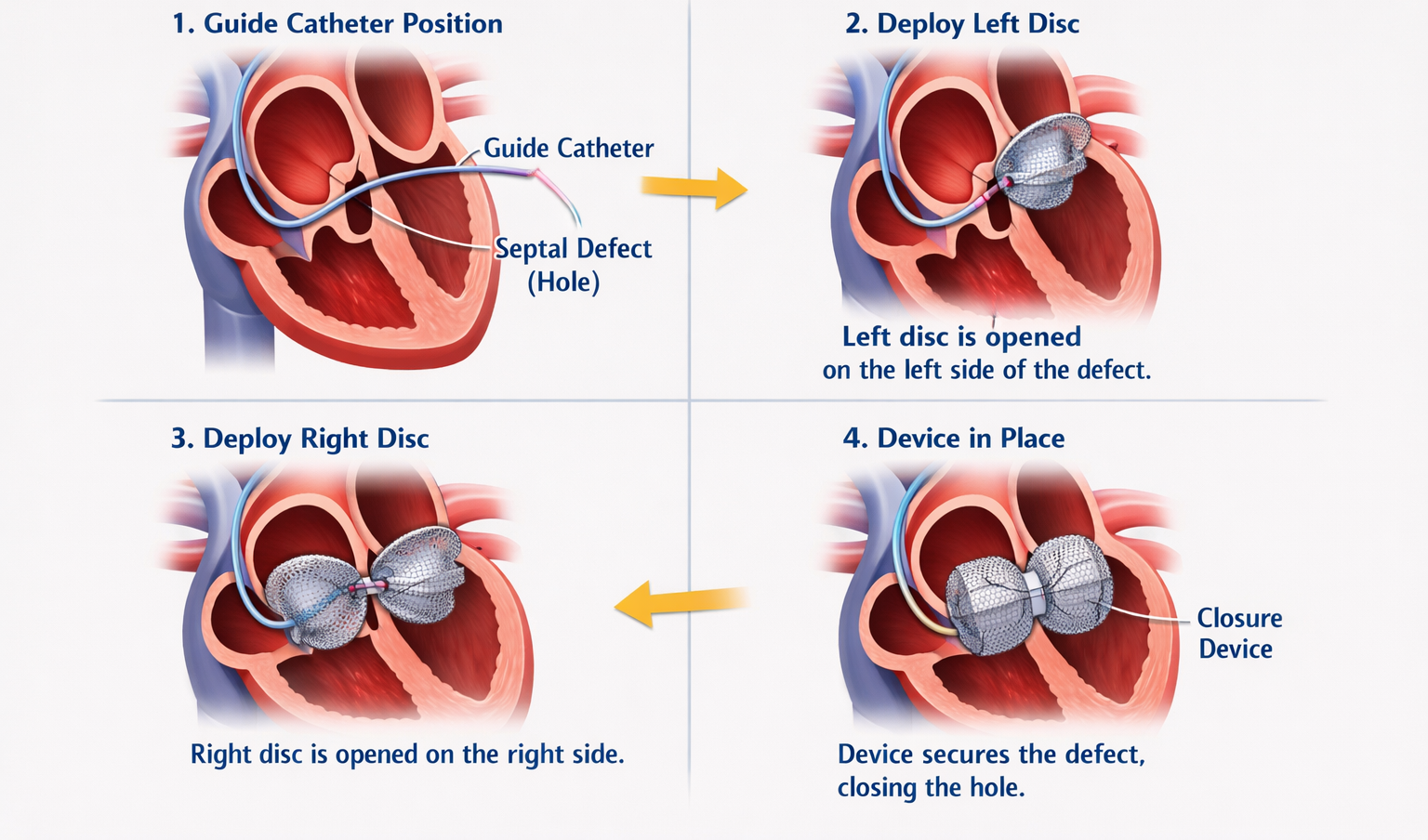
  1. Preparation: The procedure is usually performed under local anesthesia or mild sedation
  2. Catheter Insertion: A catheter is inserted through a vein in the groin and guided to the heart
  3. Device Placement: The closure device is positioned across the defect using imaging guidance
  4. Deployment: The device expands and seals the opening permanently
  5. Completion: The catheter is removed, and the incision site is closed

The procedure typically takes 1–2 hours, and most patients can go home within a day or two.

Benefits of Device Closure
  • Minimally invasive procedure with no major surgery
  • Shorter hospital stay and faster recovery
  • Reduced risk compared to open-heart surgery
  • Minimal scarring and less pain
  • Effective long-term closure of heart defects
Risks and Considerations
  • Device displacement (rare)
  • Bleeding or infection at the catheter site
  • Arrhythmias (irregular heart rhythm)
  • Residual shunt in some cases
  • Need for follow-up monitoring and medications
Recovery After Device Closure
  • Most patients recover quickly and resume normal activities within a few days
  • Regular follow-up with echocardiography is required
  • Temporary medications such as blood thinners may be prescribed
  • Maintaining heart health through lifestyle changes is recommended
Why Choose Dr. Gnanadev N C for Device Closure Procedures?

Dr. Gnanadev N C offers expert care in performing device closure procedures for ASD, VSD, and PDA using advanced catheter-based techniques. With extensive experience in interventional cardiology, he ensures accurate diagnosis, precise device placement, and comprehensive follow-up care.

Patients benefit from minimally invasive treatment, faster recovery, and long-term improvement in heart function, ensuring a better quality of life.

Get in Touch for Expert Heart Care

Contact us for timely diagnosis, expert guidance, and compassionate heart care.